
Introduction
Sermon Reflection | Fenton First Presbyterian Church | Fenton, Michigan
Pastor Robbie Carnes
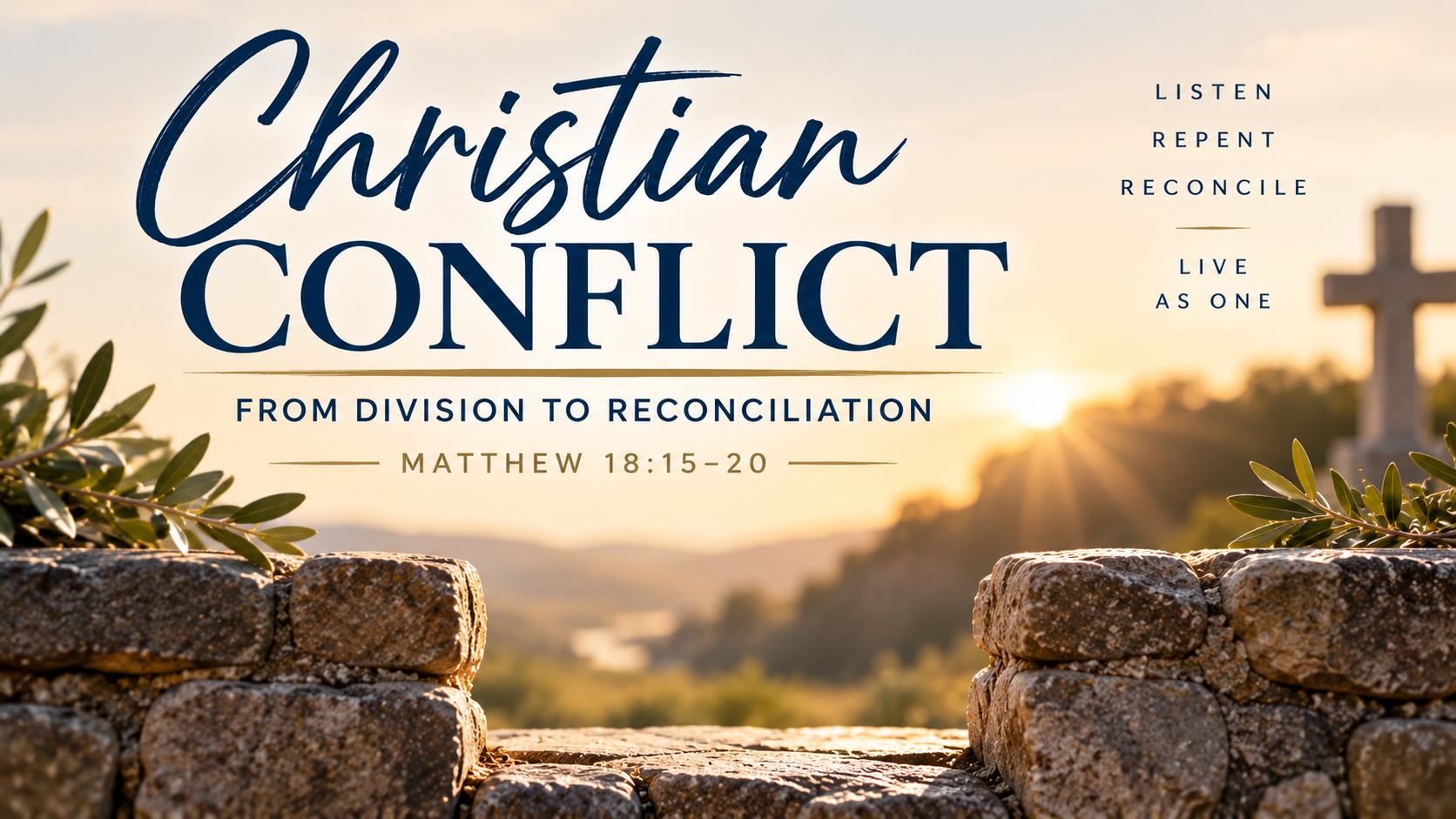
Scripture: Matthew 18:15–20
Sermon Beyond Sunday: Christian Conflict
Conflict is part of life. Families disagree. Friendships become strained. Churches experience tension. Sometimes we know exactly what happened; other times we simply realize that a relationship isn't what it used to be.
Our usual response may be to avoid the difficult subject, complain to someone else, or simply decide not to talk about it anymore. But is avoiding conflict the same thing as reconciliation?
In Matthew 18, Jesus gives His followers another way. His instructions aren't designed to help us win an argument or prove who is right. They are designed to protect dignity, restore relationships, and preserve community. And as Sunday's sermon reminded us, reconciliation begins with a willingness to do something that can be incredibly difficult: go to one another.
Reflection
Jesus' instructions in Matthew 18 begin simply:
“If your brother or sister sins against you, go and point out the fault when the two of you are alone.”
Notice what Jesus doesn't say. He doesn't say to tell everyone else what happened. He doesn't tell us to gather supporters, post about it publicly, or quietly allow resentment to grow.
He says: Go to the person.
There is something profoundly respectful about that. Addressing someone privately protects their dignity and gives both people an opportunity to speak honestly. If that doesn't resolve the conflict, Jesus says to bring one or two trusted people along—not to gang up on the other person, but to help move the relationship toward understanding and reconciliation.
But Sunday's message turned the question around: What happens when we are the ones who caused the harm?
Scripture has quite a bit to say about that too. Throughout the Old Testament, repentance isn't merely feeling bad or saying the right words. Repentance means returning. It requires acknowledging what has happened and doing something about it. In Numbers, confession is accompanied by restitution. In the prophets, God's people are repeatedly called not simply to say they have changed, but to actually return to God and live differently.
That led Sunday's sermon into a practical look at what genuine repentance and repair can involve.
First, name and own the harm. There is an enormous difference between saying, “I'm sorry you felt that way,” and saying, “I did something that hurt you.” Genuine repentance begins when we stop defending ourselves long enough to acknowledge what we actually did.
Second, stop doing the harmful thing. If our actions are hurting someone, an apology means very little if we simply continue the behavior. Repentance begins producing change.
Third, make restitution when possible and accept the consequences. Sometimes something we've done can be repaired. Other times, consequences remain. Trust may need to be rebuilt slowly. A relationship may not immediately return to what it once was—and sometimes it may never be exactly the same.
That's difficult, because forgiveness doesn't erase consequences. Part of genuine repentance is having the courage to acknowledge that our choices affected another person and that they may need time, space, or boundaries as healing takes place.
Then comes something surprisingly simple:
Say, “I'm sorry.”
It might seem strange that the actual apology comes after so much work. We often want those words to come first. But Sunday's message invited us to consider how much more meaningful “I'm sorry” becomes when our actions have already begun demonstrating that we mean it.
An apology shouldn't be a shortcut around accountability. It shouldn't be a way of making ourselves feel better or pressuring the other person to forgive us quickly. Repentance gives power to the words of an apology because our actions begin to support what our lips are saying.
Finally, genuine repentance means making different choices going forward. It isn't enough to stop harmful behavior temporarily. We begin asking what needs to change so that we don't simply repeat the same pattern. That may require accountability, new habits, difficult conversations, or a willingness to approach relationships differently.
This is where reconciliation becomes more than conflict management. It becomes part of our spiritual growth.
And yet there is another side to this. Even if we have apologized, made restitution, and changed our behavior, we cannot demand forgiveness from another person. We cannot use Jesus' instructions as a formula that obligates someone else to respond the way we want.
Reconciliation cannot be forced.
That brings us to the image that closed Sunday's sermon: the Communion table.
A table has sides, but everyone gathered around it has a place. We don't come to Christ's table to determine who won the argument. We don't gather there to gang up on the person who hurt us or pressure the person we've hurt.
We come because Jesus died for you and Jesus died for me.
We come because we all need grace.
We come because Christ is creating a community.
As Sunday's sermon put it:
“It isn't about winning. Jesus has already won.”
The goal is not for me to be proven right or for you to be proven wrong. The goal is for all of us to be reconciled through Christ, seeing one another through the lens of the One who has already reconciled us to God.
Living the Message
Most of us can probably think of a relationship where something remains unresolved. But before thinking about what someone else needs to apologize for, Jesus' invitation gives us an opportunity to examine ourselves.
Is there harm I need to own?
Maybe there are words we need to acknowledge, behavior we need to stop, restitution we need to make, consequences we need to accept, or simply a sincere “I'm sorry” that needs to be spoken.
Reconciliation doesn't mean pretending nothing happened. It doesn't mean ignoring healthy boundaries or demanding that every broken relationship return to exactly what it was before.
It means allowing Christ to change the way we approach one another. Instead of asking, How do I win this? we begin asking, What would faithfulness, repentance, and love look like here?
A Challenge for the Week
Think of one relationship in your life where there is tension, hurt, or something unresolved. Before deciding what the other person needs to do, spend some time asking God:
“Lord, show me my part.”
If you caused harm, name it honestly. Ask whether there is something you need to stop doing, repair, acknowledge, or change. If a conversation is appropriate, pray for the humility and courage to have it directly and respectfully.
And when conflict comes this week—as it eventually will—remember the table.
Jesus died for me. Jesus died for you. We both come by grace.
This Week's Prayer
Gracious and reconciling God,
You know how easily conflict separates us. You know the words we've spoken, the wounds we've caused, the hurts we carry, and the conversations we've avoided.
Give us courage to seek reconciliation rather than simply avoiding conflict. When we have caused harm, give us humility to name it without excuses, strength to change our behavior, willingness to make repair where possible, and grace to accept the consequences of our choices.
Keep us from using apologies to manipulate others or forgiveness as something we demand. Teach us instead the patient work of repentance, repair, and renewed relationship.
When we are tempted to prove ourselves right, bring us back to Your table. Remind us that Jesus has already won and that each of us comes to Him in need of the same mercy.
Help us see one another through the lens of Christ and become a community shaped not by winning and losing, but by truth, grace, accountability, forgiveness, and love.
In Jesus' name we pray.
Amen.
Join Us This Sunday
If you're looking for a church in Fenton, Michigan, or searching for a welcoming Christian community where you can grow in faith, ask honest questions, and experience meaningful worship, we'd love to welcome you.
At Fenton First Presbyterian Church, we seek to know Jesus Christ and grow, share, and serve as His disciples. Whether you've attended church your whole life or you're exploring faith for the first time, there is a place for you here.
Join us this Sunday as we continue discovering God's Word together and learning how Christ meets us in every season of life—even in the midst of the storms.
Come as you are. We look forward to welcoming you.
About Sermon Beyond Sunday: Each reflection is created from the pastor’s sermon transcript and uses AI-assisted technology to help adapt the spoken message for continued reflection throughout the week. The Scripture, message, and theological themes are drawn directly from the sermon.