
Introduction
Sermon Reflection | Fenton First Presbyterian Church | Fenton, Michigan
Pastor Lindsey Carnes
Scripture: John 9:1-11
Sermon Beyond Sunday: Jesus and the Man Born Blind
Have you ever put on a new pair of glasses and suddenly realized how much you weren't seeing?
Pastor Lindsey began Sunday's message by recalling videos of young children receiving glasses for the first time. A face that had only been a blur suddenly becomes clear. A familiar voice finally has a face attached to it. Even for those of us who received glasses later in life, there can be that surprising realization: I didn't know what I was missing.
In John 9, Jesus meets a man who has never experienced sight at all. Yet as his story unfolds, we discover that physical blindness is only one kind of blindness—and surprisingly, the man who begins the story unable to see becomes the person who ultimately sees Jesus most clearly.
Reflection
When the disciples see the man who has been blind from birth, their first question isn't, How can we help him? Instead, they ask:
“Rabbi, who sinned, this man or his parents, that he was born blind?”
They want an explanation. Someone must be responsible. Someone must have done something wrong. Jesus immediately challenges their assumption:
“Neither this man nor his parents sinned.”
Pastor Lindsey reminded us that people in Jesus' time often connected suffering, illness, or disability directly with someone's sin. If something terrible had happened to you, perhaps you—or someone in your family—had done something to deserve it.
We may like to think we've moved beyond that kind of thinking, but perhaps we haven't moved quite as far as we'd like to believe. Sometimes we look at people who seem successful and assume they must somehow be more blessed. At other times, we see someone struggling and quietly wonder what choices brought them there. And sometimes we turn that same judgment upon ourselves: Why is this happening to me? What did I do wrong? Why does everyone else seem to have this figured out?
Jesus sees something the disciples cannot. There is more here than meets the eye.
The man has spent his entire life in darkness. Pastor Lindsey invited us to imagine what that must have been like. He had heard other people describe faces, trees, sunlight, colors, buildings, and everything else around him, but he had no visual memories to help him understand what they meant.
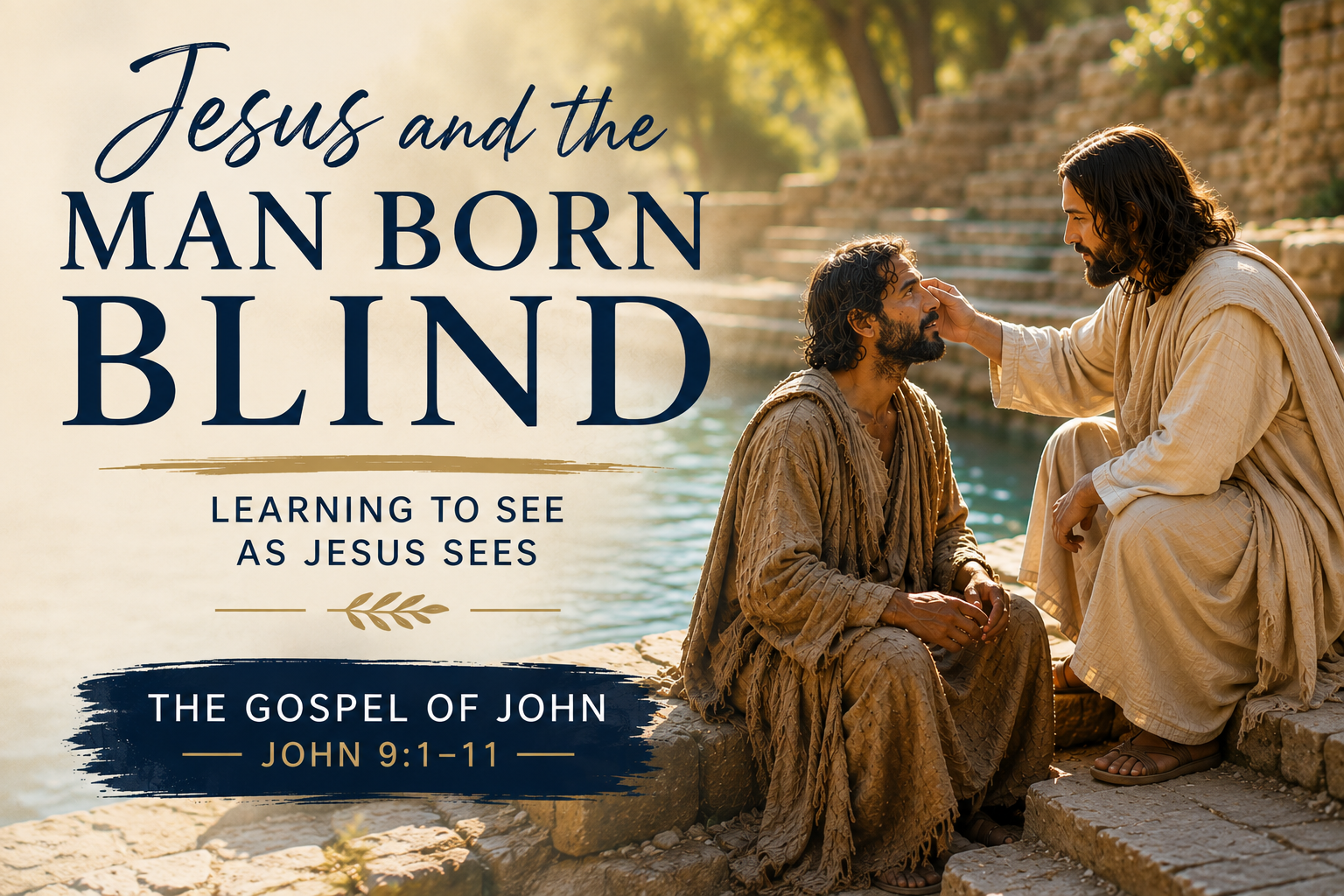
Then Jesus comes along. He spits on the ground, makes mud, places it on the man's eyes, and tells him to wash in the Pool of Siloam. It's a strange way to perform a miracle.
During the children's message, Pastor Robbie used Play-Doh to make the point. We can shape something that looks like an eyeball, but no matter how carefully we form it, we cannot make it see. Only God can give life. Only God can truly remake what is broken.
The man goes to the pool, washes—and for the first time in his life, he can see. You might expect the rest of John 9 to be a joyful celebration. It isn't.
The actual healing takes only a couple of verses. The story surrounding it stretches much further because almost everyone else has trouble seeing what has happened. The neighbors argue about whether this is really the same man who used to beg. Rather than celebrate the miracle standing in front of them, they question whether it happened at all.
The Pharisees acknowledge something happened, but they become fixated on the fact that Jesus healed on the Sabbath. Their rules prevent them from seeing the grace of God unfolding right before their eyes. Then there are the man's parents. They know their son was born blind, yet fear keeps them from saying too much. They worry about being thrown out of the synagogue, so they tell the authorities, essentially, He's an adult. Ask him.
And that leads to one of Pastor Lindsey's most important questions:
Is there anyone in this story who hasn't been born blind in some way?
The neighbors are blinded by their assumptions. The Pharisees are blinded by their rules. The parents are blinded by fear. And yet the man who began the story physically blind is slowly learning to see.
At first, he simply calls Jesus “the man called Jesus.” Later, when asked what he thinks about Jesus, he answers, “He is a prophet.” His vision is becoming clearer.
When the religious leaders continue questioning him, he doesn't pretend to have all the theological answers. Instead, he gives one of the simplest and most powerful testimonies in Scripture:
“One thing I do know, that though I was blind, now I see.”
He doesn't need to win an argument. He simply tells the truth about what Jesus has done in his life.
Eventually, the Pharisees throw him out of the synagogue. His parents have stepped away. His community has rejected him. And then Jesus comes looking for him.
That detail matters. The man doesn't have to find his way back to Jesus. Jesus returns for him.
Jesus asks, “Do you believe in the Son of Man?” The man responds with a question: “And who is he, sir? Tell me, so that I may believe in him.”
Pastor Lindsey pointed out that sometimes our questions reveal more about us than our answers. This man's question reveals humility, openness, and a willingness to believe. Jesus tells him:
“You have seen him, and the one speaking with you is he.”
The man responds, “Lord, I believe.” And he worships Him. The man who couldn't see at the beginning of the story now sees what everyone else has missed. He sees Jesus.
Pastor Lindsey closed Sunday's message with the story of an artist who noticed a homeless man sitting across the street from his studio. The man looked defeated—eyes downcast, sitting with his hat out asking for money.
The artist painted him. But when the man saw the finished portrait, he barely recognized himself. The person in the painting sat upright. There was dignity in his face, brightness in his eyes, and determination in his expression.
“Is that me?” the man asked.
The artist answered:
“That's the person that I see in you.”
Pastor Lindsey then offered a beautiful connection: Jesus sees something in us before we see it in ourselves.
Jesus sees beyond our failures, our limitations, the labels others place upon us, and even the labels we've placed upon ourselves. He sees our dignity. He sees who we are as children of God. He sees what His grace can remake within us.
And as our eyes are opened to Christ, something else begins to happen. We start learning to see ourselves differently. And perhaps just as importantly, we begin learning to see others as God sees them.
Living the Message
There are many ways to be blind without ever losing our eyesight. Fear can blind us. Assumptions can blind us. Rules, pride, resentment, disappointment, and even familiarity can keep us from seeing what God is doing right in front of us.
So perhaps the question to carry beyond Sunday isn't simply, What am I looking at? but What am I failing to see?
Maybe there is someone you've reduced to a label or an assumption. Maybe there is something happening in your own life that you've interpreted only as failure. Or perhaps you've become so convinced of your own limitations that you can no longer imagine God seeing anything different in you.
Christ invites us to see differently—not by pretending brokenness isn't real, but by learning to look at ourselves, our neighbors, and our circumstances through the eyes of grace.
A Challenge for the Week
Each morning this week, begin with a simple prayer:
“Jesus, help me see what You see today.”
Then pay attention. Notice the person you might normally overlook. Question an assumption you've made about someone. Look for God's presence in a situation you've already decided is hopeless.
And when you look at yourself, remember the artist's words from Sunday's story: “That's the person that I see in you.” Ask Christ to help you see yourself with the same dignity, grace, and possibility that He sees in you.
This Week's Prayer
Jesus, Light of the World,
Open our eyes. Forgive us for the times we have looked at the struggles of others and rushed to judgment. Forgive us when fear, pride, assumptions, or our own expectations prevent us from seeing Your grace at work.
When we cannot see a way forward, remind us that You see what we cannot. When we feel defined by our failures, limitations, or wounds, help us remember that You see something more.
Give us eyes to recognize Your presence, courage to ask honest questions, and faith to follow even when we do not have every answer. Teach us to see ourselves as You see us—with dignity, love, forgiveness, and hope. Then open our eyes to see those around us in the same way.
May we be able to say with the man You healed, “I was blind, but now I see.” And having seen You more clearly, may our lives respond in worship.
Amen.
Join Us This Sunday
If you're looking for a church in Fenton, Michigan, or searching for a welcoming Christian community where you can grow in faith, ask honest questions, and experience meaningful worship, we'd love to welcome you.
At Fenton First Presbyterian Church, we seek to know Jesus Christ and grow, share, and serve as His disciples. Whether you've attended church your whole life or you're exploring faith for the first time, there is a place for you here.
Join us this Sunday as we continue discovering God's Word together and learning how Christ meets us in every season of life—even in the midst of the storms.
Come as you are. We look forward to welcoming you.