
Introduction
Sermon Reflection | Fenton First Presbyterian Church | Fenton, Michigan
Pastor Lindsey Carnes
Scripture: John 8:1-11
Sermon Beyond Sunday: The Savior and the Sinner
What happens when our worst moment becomes the thing everyone else sees?
In John 8:1–11, a woman is brought before Jesus after being caught in adultery. Her sin is exposed publicly, her accusers are ready to condemn her, and she is placed at the center of a trap intended for Jesus.
Yet what unfolds is not simply a story about judgment or even forgiveness. It is a powerful picture of grace—grace that sees our sin honestly but refuses to let sin have the final word.
As we move beyond Sunday's worship, we return to this familiar story and to Jesus' life-changing words:
“Neither do I condemn you. Go your way, and from now on do not sin again.”
Reflection
The scene is uncomfortable from the very beginning.
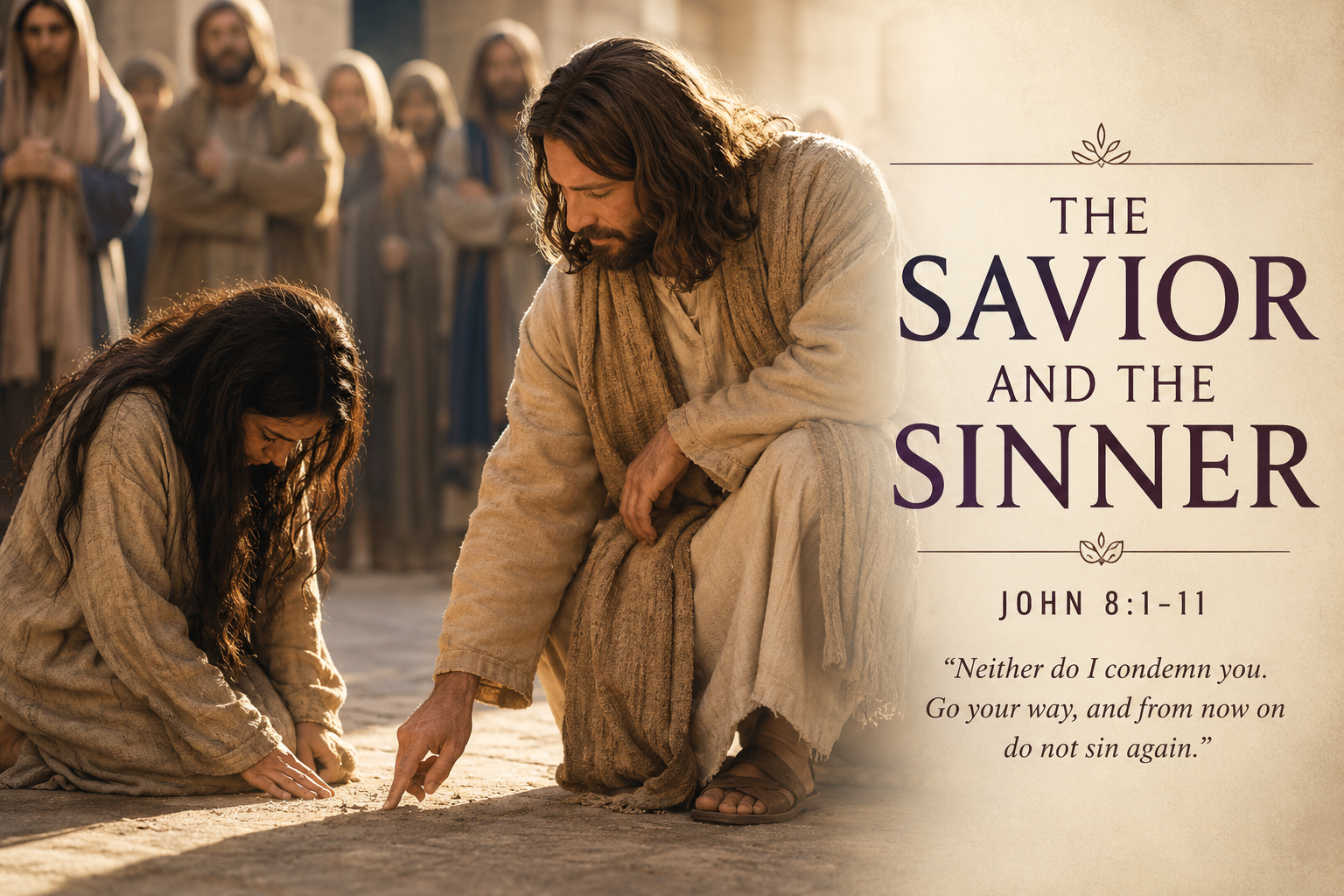
Jesus is teaching in the Temple when the scribes and Pharisees push their way through the crowd, bringing with them a woman caught in adultery. They make her stand before everyone.
She has a sin, but she doesn't even have a name. And that tells us something about the people who brought her.
They weren't primarily concerned about her spiritual well-being. They weren't seeking restoration or reconciliation. The woman had become useful to them—not as a person in need of God's mercy, but as a way to trap Jesus.
Even the circumstances raise questions. If she was caught “in the very act” of adultery, where was the other person? Why was only the woman dragged publicly before Jesus? Something isn't right.
Pastor Lindsey pointed out that the religious leaders were not really seeking Jesus' wisdom. They were attempting to force Him into an impossible choice. If He rejected the punishment prescribed by the law, they could accuse Him of disregarding Moses. If He called for her death, He would create another set of problems. They believed they had trapped Him.
But Jesus does something unexpected. He bends down and writes on the ground.
We aren't told what He wrote. Christians have wondered about it for centuries, but perhaps that's precisely the point. Scripture doesn't tell us because what Jesus said matters far more:
“Let anyone among you who is without sin be the first to throw a stone at her.”
Suddenly, the focus shifts. The accusers wanted Jesus to examine the woman. Jesus asks the accusers to examine themselves.
Pastor Lindsey reminded us that Jesus wasn't simply saying that no imperfect person can ever make a moral judgment. He was forcing these accusers to confront their own motives, their own honesty, and their own relationship to the very law they were attempting to use against this woman.
Before picking up the stone, they needed to look in the mirror.
One by one, beginning with the older ones, they walk away until eventually only Jesus and the woman remain.
There is something remarkable about that moment. The only person standing there who truly was without sin—the only one qualified to condemn her—doesn't pick up a stone.
Instead, Jesus asks, “Woman, where are they? Has no one condemned you?”
“No one, sir.”
Then come the words that change everything:
“Neither do I condemn you.”
But Jesus doesn't stop there. He continues:
“Go your way, and from now on do not sin again.”
That order matters.
Jesus doesn't tell her, “Fix your life, and then perhaps I'll accept you.” He doesn't tell her, “Prove that you've changed, and then I'll forgive you.”
Grace comes first.
Neither do I condemn you.
Then comes the invitation to a different life:
Go and sin no more.
That distinction lies at the heart of the Gospel. We don't change ourselves so that God will finally love us. We are changed because we discover that, through Christ, we are already loved.
As Pastor Lindsey put it so beautifully:
“We don't have to change in order to be accepted in God's kingdom. We change because we have already been accepted.”
Grace doesn't pretend sin doesn't matter. Jesus never tells the woman that adultery is acceptable or that what happened is insignificant. Instead, He forgives her and then calls her toward a new way of living.
Grace changes what rules never can.
That same grace was reflected earlier in worship through a simple question during the children's message:
Is there anything you can do to make God stop loving you?
The answer points us toward one of the deepest truths of our faith. Our failures don't change the fundamental truth of who we are. We belong to God. We are God's children.
That doesn't mean our choices don't matter. It means our mistakes don't erase God's love or God's desire to restore us.
The woman standing before Jesus had been reduced by everyone around her to the worst thing she had done. Jesus saw more.
He treated her with dignity and compassion. He acknowledged her sin honestly, offered forgiveness, and then sent her forward into a new life.
Her worst moment didn't have to become her identity. Her story wasn't over.
As Sunday's message reminded us:
“Every saint has a past and every sinner has a future.”
That's true for the woman standing before Jesus. And it's true for us.
We all carry things we regret. We all have thoughts, choices, failures, and wounds we'd rather other people never see. Sometimes we're painfully aware of them. Other times, like the Pharisees, we're much better at identifying someone else's failures than recognizing our own.
But the Gospel calls us away from both condemnation and self-righteousness.
At the feet of Jesus, there are no people holding stones and people deserving stones. There are sinners in need of grace—and there is a Savior who offers it.
Living the Message
It's easy to read this story and immediately identify with the woman surrounded by judgment. But perhaps this week we should also ask whether we've ever found ourselves standing among the crowd holding a stone.
Our stones may not be literal. They can look like gossip, resentment, assumptions, harsh words, social media comments, or quietly deciding that someone's worst decision tells us everything we need to know about them.
Jesus invites us to put those stones down. But He also invites us to put down the stones we aim at ourselves.
Maybe there is something in your past you still believe disqualifies you from God's love. Maybe you've asked for forgiveness but continue carrying shame long after Christ has offered grace.
Hear Jesus' words again:
“Neither do I condemn you.”
And then hear what comes next:
“Go.”
Grace doesn't leave us trapped in the past. It gives us the freedom to walk toward something new.
A Challenge for the Week
This week, pay attention to the moments when you're tempted to condemn—either someone else or yourself.
When it happens, pause before picking up the stone and ask:
Am I responding with the same grace Jesus has shown me?
Then choose one tangible act of grace. Forgive someone. Stop yourself from repeating a piece of gossip. Reach out to someone you've judged too quickly. Offer encouragement instead of criticism.
And if the person you're struggling to forgive is yourself, spend a few quiet moments remembering the promise Pastor Lindsey shared at the conclusion of Sunday's message:
“There is therefore now no condemnation for those who are in Christ Jesus.” — Romans 8:1
Let grace have the final word.
This Week's Prayer
Gracious and merciful God,
Thank You that You see us completely and still meet us with love. You know the things we're proud of and the things we wish we could hide, yet You continue to call us Your children.
Forgive us for the times we have been quick to judge others while overlooking our own need for grace. Help us put down the stones we carry—the resentment, assumptions, anger, and self-righteousness that keep us from seeing others as Your beloved children.
And when we are the ones carrying shame, remind us that our failures do not have the final word. Help us hear the voice of Jesus saying, “Neither do I condemn you.”
Give us courage to receive Your forgiveness and then walk forward into the new life You offer. May the grace we have received become the grace we extend to others.
In the name of Jesus Christ, who came not to condemn the world but to save it, we pray.
Amen.
Join Us This Sunday
If you're looking for a church in Fenton, Michigan, or searching for a welcoming Christian community where you can grow in faith, ask honest questions, and experience meaningful worship, we'd love to welcome you.
At Fenton First Presbyterian Church, we seek to know Jesus Christ and grow, share, and serve as His disciples. Whether you've attended church your whole life or you're exploring faith for the first time, there is a place for you here.
Join us this Sunday as we continue discovering God's Word together and learning how Christ meets us in every season of life—even in the midst of the storms.
Come as you are. We look forward to welcoming you.